Treatment & biofeedback
Treatment & biofeedback
Everything begins with a 60-minute assessment. What follows depends on what we find — usually a course of six to ten sessions, sometimes a single consultation and a plan you carry out yourself.
Prices below are our self-pay rates, including VAT where it applies. Therapeutic treatment by a licensed physiotherapist is exempt from VAT under § 4 no. 14 a UStG; the course fee is charged as a preventive service.
With a valid Heilmittelverordnung your statutory insurer pays for the treatment listed on it and you pay only the statutory co-payment. What is not on the prescription — a biofeedback session, for example — is a self-pay service, and we say so before we do it.
Initial assessment
60 minutes
€98
Covered by statutory insurance as the first treatment on a Heilmittelverordnung; otherwise self-pay.
The full first appointment: history, examination, explanation and a written plan. Everybody starts here.
A structured history of bladder, bowel, sexual function, pregnancy and surgery, plus your medication and your daily loads — about twenty minutes, sitting down, fully clothed.
A physical examination: breathing and pressure management, posture and load transfer, abdominal wall, and pelvic floor function. Pelvic floor function can be assessed externally, by ultrasound-free palpation of the perineum, or internally, vaginally or rectally. We explain each option, you choose, and you can decline any of them and still be treated.
A written plan you take home: what we found, what we think is driving it, what we propose, how many sessions, and what you do between them.
Questions per treatment
Do I have to undress?
Not for the conversation and not for the movement assessment. For an internal examination you undress from the waist down and are covered with a sheet; there is a screen and time on your own to change.
Can I bring somebody?
Yes. A partner, a friend or a relative can be in the room for all of it, part of it, or none of it. We can also provide a second member of staff as a chaperone if you would rather not bring anybody.
What should I bring?
Your prescription if you have one, your insurance card, a list of your medication, and any relevant letters — operation report, urodynamics, gynaecological findings.
EMG biofeedback session
30 minutes
€58
EMG biofeedback is not a position in the Heilmittelkatalog and is therefore a self-pay service, also for statutory patients. Some private insurers and supplementary policies reimburse it; ask your insurer before your appointment.
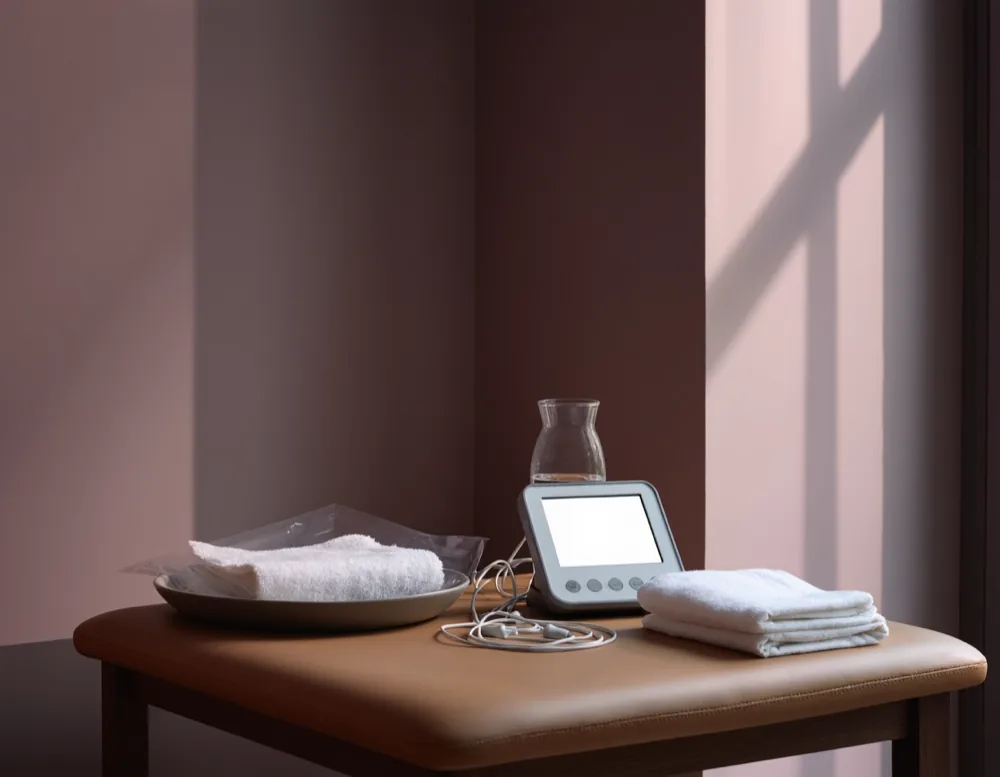
Surface EMG makes an invisible muscle visible on a screen, so you can see whether you are contracting, releasing, or bracing with everything else.
Surface electrodes pick up the electrical activity of the pelvic floor and display it as a live curve. You see the contraction start, hold and — the part most people never manage on their own — release completely.
Sensors can be external, placed on the perineum or beside the anus, or internal, vaginal or rectal. External sensors are less precise but perfectly usable, and are what we start with unless you prefer otherwise.
Biofeedback is a teaching tool, not a treatment in itself. It shortens the learning phase and it is most useful when you cannot feel the muscle at all — after prostate surgery, after an obstetric injury, or when the pelvic floor is chronically overactive.
Questions per treatment
Does it hurt?
No. The device only reads muscle activity, it does not stimulate. Internal sensors can feel unfamiliar; they should never be painful, and we stop if they are.
Is the sensor single-use?
Internal probes are single-patient items which we hand over to you and which you bring to each session; adhesive surface electrodes are single-use.
Can I do biofeedback without an assessment?
No. Without a baseline the curve on the screen means very little, and an overactive pelvic floor trained as if it were weak gets worse.
Post-partum recovery course
8 × 60 minutes, groups of six
€160
reimbursed by most statutory insurers
The course is certified as a preventive course under § 20 SGB V. Statutory insurers typically reimburse 80–100 % of the fee once you have attended at least 80 % of the sessions; the exact rate and the number of courses per year are set by your insurer, so please confirm with them before you book. You pay us the fee and we issue the attendance certificate you submit. A midwife-led Rückbildungskurs is a separate, directly covered benefit under § 24d SGB V — you may be entitled to that as well.
A structured eight-week course for the phase after birth: breathing, pressure, pelvic floor, abdominal wall, and getting back to load.
Weeks one and two: breath, pressure management, gentle activation, and what a diastasis actually is. Weeks three to six: graded loading, carrying and lifting a growing child, standing up under load. Weeks seven and eight: return to running, to the gym, and to what you did before.
Groups are capped at six. Babies are welcome; there is floor space, a changing surface and no expectation that anybody finishes a sentence.
Starts eight weeks after a vaginal birth and ten to twelve weeks after a caesarean, in each case after your post-natal check.
Questions per treatment
Is this the same as the midwife's course?
No. A midwife-led Rückbildungsgymnastik is a maternity benefit your insurer pays directly. Ours is a physiotherapy-led preventive course with a heavier focus on load and return to sport. Many patients do both, in that order.
What if I miss a week?
You can make up two sessions in the following course. Below 80 % attendance your insurer will usually not reimburse the fee.
I gave birth three years ago. Am I too late?
No. There is no window that closes. If you are more than a year post-partum an individual assessment is usually the better starting point.
Continence training after prostate surgery
45 minutes
€78
Usually prescribable on a Heilmittelverordnung by your urologist or in follow-up rehabilitation; otherwise self-pay at the rate shown. Biofeedback within the session is billed separately as a self-pay service.
Individual treatment before and after radical prostatectomy, TURP or radiotherapy — sphincter timing, endurance, and a plan for the working day.
Before the operation, if there is time: finding the muscle, learning to time it, and building a baseline. This is the single most useful appointment in the whole pathway.
After catheter removal: timing before the cough, before standing and before the first step; graded endurance; pad-count as a measure; fluid and caffeine strategy; and a realistic curve of what improves when.
Later problems are also treated here — pelvic pain, an overactive floor after radiotherapy, and pelvic floor contributions to erectile function, in coordination with your urologist.
Questions per treatment
How soon after the operation can I start?
Gentle activation usually as soon as the catheter is out and your surgeon agrees; loaded training a little later. We follow your surgical team's protocol, not a general rule.
Will I be dry again?
Most patients improve substantially over the first six to twelve months, and structured pelvic floor training brings that forward. Nobody can promise you a result, and we will not.
Is the therapist male?
Jonas Reinke treats most of our post-prostatectomy patients. You may request a therapist of any gender and it changes nothing about the treatment.
Follow-up treatment
45 minutes
€72
Statutory: covered on a prescription, co-payment applies. Private and self-pay: the rate shown.
The standard individual session after the assessment: manual therapy, training, progression and review.
Manual techniques for the pelvic floor, abdominal wall, hips and scars where indicated, always combined with active work — the passive part on its own does not hold.
Progression of your home programme, which is written down and takes between five and fifteen minutes a day, not an hour.
Review of your diary, your pad count or your pain scores, so that we can both see whether this is working. If it is not working by session six, we change the plan or send you back to your doctor.
Questions per treatment
How many sessions will I need?
A typical prescription is six sessions and a typical course of treatment is six to ten. We tell you our estimate in writing after the assessment.
Do you treat during pregnancy?
Yes, throughout, and it is one of the most useful times to come.
Video appointment
30 minutes
€48
Billed as a self-pay service. Whether a prescribed treatment may be delivered as video therapy depends on the position on your prescription and on your insurer's agreement — we clarify that before the appointment rather than after it.
Exercise instruction, diary review, progress check and education, from wherever you are.
Suitable for follow-up, for reviewing a bladder or bowel diary, for adjusting a home programme, and for the education-heavy parts of a treatment. Not suitable for a first assessment or for any hands-on work.
Runs through a certified German video consultation service in the browser — no account, no app, no recording. You will get a link and a one-time code by your chosen contact route.
You need about a square metre of floor, a device you can prop up, and a door you can close.
Questions per treatment
Is the video call recorded?
No. Nothing is recorded, stored or transcribed. The service is certified for use in German healthcare and processes data in Germany.
Can I do a video appointment from work?
Please do not. You will be talking about bladders and bowels and doing floor exercises. A room you can close is part of the treatment.
EMG biofeedback session
How biofeedback actually works
Most people cannot feel their pelvic floor properly. That is not a personal failing — it is a small, deep, unpractised muscle group with poor cortical representation, and the standard advice to "squeeze as if you were stopping the flow of urine" produces a wrong contraction in a considerable proportion of adults. Many people push down instead of lifting, or they brace the abdomen, the buttocks and the jaw and never move the pelvic floor at all.
Surface EMG biofeedback puts that activity on a screen in real time. It does not treat anything by itself. What it does is close the loop: you try something, you see immediately whether it worked, and the learning takes days instead of weeks.
1 · Baseline
At rest, we look at whether the muscle is quiet. A resting line that never comes down is an overactive pelvic floor, and it is trained in the opposite direction to a weak one.
2 · Contraction
Height, speed of onset and whether you can hold. We compare it against the abdominal channel to see whether you are recruiting the pelvic floor or the rest of you.
3 · Release
The part almost everybody skips. A muscle that cannot let go cannot work again quickly, and incomplete release is one of the commonest findings in pelvic pain and urgency.
4 · Timing
Contraction against a cough or a lift, in advance rather than after. Continence is mostly a timing problem, and timing is the thing biofeedback teaches fastest.
Consent, dignity and how examinations are handled
An internal examination is proposed, never assumed. We explain what would be assessed, how, and what it would tell us; you may agree to it at the first appointment, at the fifth, or never.
You may bring a person of your choice, or ask for a member of our staff to be present as a chaperone, at no cost and without giving a reason. You may stop any examination at any moment with a word, and it stops.
You undress alone behind a screen and are covered throughout. Gloves and lubricant are single-use. Nothing is photographed, and nothing is recorded.
Our records contain what is clinically necessary and no more. We are bound by professional confidentiality under § 203 StGB, which covers everybody in the practice including the person who answers the telephone.
Legal
Insurance, prescriptions and what you pay
German physiotherapy billing is not intuitive. Here is the version we would want to read.
Statutory insurance (GKV) with a prescription
Pelvic floor physiotherapy is prescribed by your gynaecologist, urologist, proctologist, surgeon or GP on a Heilmittelverordnung (Muster 13). Our practice bills your insurer directly for the treatments listed on it.
You pay the statutory co-payment: 10 % of the treatment cost plus €10 per prescription, unless you hold a current exemption certificate. That is set by § 61 SGB V and is the same in every practice in Germany.
Treatment must begin within 28 days of the date the prescription was issued — 14 days if the doctor has marked it as urgent (dringlicher Behandlungsbedarf). Bring the prescription to the first appointment; we cannot bill without the original.
Pelvic floor work is normally prescribed as KG (Krankengymnastik); many referrers write "KG Beckenboden" as a note to the practice. If your doctor is unsure what to write, ask them to call us — it takes two minutes and saves a rejected prescription.
Private insurance and Beihilfe
We invoice you directly according to our private schedule, based on the GebüH. You submit the invoice to your insurer and, where applicable, to your Beihilfe office.
How much comes back depends entirely on your tariff — some policies reimburse in full, some cap the number of sessions per year, some exclude preventive services. Please check your tariff before the first appointment rather than after the sixth.
A doctor's prescription is not legally required for private patients in most tariffs, but many insurers ask for one, so it is usually worth getting.
Self-pay (Selbstzahler)
You can come to us without a prescription and without involving any insurer at all. Many of our patients choose this deliberately, because nothing about the appointment then appears in an insurance file.
You get an invoice with the treatments and the dates. It is yours to submit or to file away.
EMG biofeedback is a self-pay service for everybody, statutory patients included, because it is not a position in the Heilmittelkatalog.
Prices are valid from 1 January 2026. We are a private practice with a health-insurance approval (Kassenzulassung, IK 461238795) and we treat statutory, private and self-pay patients in the same rooms, with the same appointment lengths.