Conditions we treat
What we treat
Pelvic floor problems are common, they are medical, and they have names. We use those names here, because they are the words you will need with your doctor and the words you probably typed into a search box to find us.
Nothing on this page is a diagnosis. It describes what we see in the practice and what treatment usually involves, so that you can decide whether an assessment is worth your time.
An assessment always starts with a conversation and a movement examination. An internal vaginal or rectal examination is often the most informative way to assess pelvic floor muscle function, but it is never a condition of treatment — we ask separately, we explain what we would do, and a great deal can be assessed without it.
01
Stress urinary incontinence
Leaking when you cough, lift or run
Most often after pregnancy and birth, around and after the menopause, after prostate surgery, and in people who lift heavily or run long distances.
Urine escapes when the pressure inside the abdomen rises faster than the closing pressure of the urethra — coughing, sneezing, laughing, lifting, jumping, the first step out of bed. It is a mechanical problem of timing and strength, not a problem of willpower.
How we treat it
Assessment of pelvic floor strength, endurance and, above all, reflex timing; graded strength training with real load; retraining the cough and lift pattern; EMG biofeedback where the muscle is hard to feel. Structured pelvic floor training resolves or substantially improves stress incontinence in a large majority of patients, and it is the first-line treatment recommended before surgery.
See a doctor first if there is blood in your urine, pain or burning when passing urine, or fever.
02
Urgency, frequency and overactive bladder
Sudden urge, going too often, getting up at night
Any adult. Frequently alongside stress incontinence — the mixed picture is the commonest of all.
A sudden, hard-to-defer urge to pass urine, going more than about eight times in the day, getting up more than once at night, or leaking on the way to the toilet. Often the bladder has learned an unhelpful habit, sometimes the pelvic floor is holding too much tone, sometimes both.
How we treat it
A three-day bladder diary, fluid and irritant review, urge-deferral technique, bladder retraining with a real schedule, down-training of an overactive pelvic floor and, where it helps, biofeedback to see the muscle release rather than grip.
See a doctor first for a suspected urinary tract infection, blood in the urine, or new urgency after a change in medication.
03
Pelvic organ prolapse
Heaviness, bulging, dragging
Most often after vaginal birth and after the menopause; also after chronic constipation, chronic cough or heavy lifting.
The bladder, rectum, uterus or vaginal wall descends into the vaginal canal, producing a feeling of heaviness, dragging or a bulge that is typically worse by the end of the day, after standing, or after lifting. Mild to moderate prolapse is very common and is not an emergency.
How we treat it
Symptom-led assessment together with your gynaecologist's staging; supervised pelvic floor muscle training, which reduces symptoms and prolapse stage in a good proportion of patients; load management for lifting, coughing and defecation; support in trying a pessary if your doctor fits one; and honest information about where physiotherapy is unlikely to be enough on its own.
See a gynaecologist if tissue is visible outside the vaginal opening, if there is bleeding, or if you cannot pass urine.
04
Recovery after birth
Post-partum rehabilitation, diastasis recti, scars
After every birth — vaginal or caesarean, first or fourth, six weeks or six years ago.
Pregnancy and birth load the pelvic floor, the abdominal wall and the connective tissue heavily. The usual picture is some combination of leaking, heaviness, a mid-line gap in the abdominal wall (diastasis recti), a perineal or caesarean scar that is tight or numb, and a body that does not yet do what it used to.
How we treat it
Breath and pressure management first, then graded loading of the pelvic floor and abdominal wall; scar mobilisation once healing allows; a return-to-running and return-to-lifting plan with actual criteria rather than a date. Our eight-session course covers the group part of this; individual problems are treated individually.
See your doctor or midwife for fever, foul-smelling discharge, heavy fresh bleeding, or a wound that opens.
05
Pain with penetration
Dyspareunia, vaginismus, vulvodynia
People of any gender and any age. Often after birth, after the menopause, after pelvic surgery or radiotherapy, alongside endometriosis, and sometimes with no identifiable trigger at all.
Pain on penetration — with a partner, with a tampon, with a dilator, or during a gynaecological or urological examination. The pelvic floor frequently responds to pain by holding tone, which makes the next attempt more painful; that loop is a physical mechanism and it can be interrupted.
How we treat it
Careful, unhurried assessment at whatever depth you consent to. Down-training and manual release of overactive muscle, breath and nervous-system work, graded exposure with dilators or trainers where appropriate, and clear coordination with your gynaecologist, urologist, pain specialist or psychotherapist. We move at the pace you set; nothing is done that you have not agreed to in advance.
New pain with bleeding, fever, or a visible lesion belongs with a doctor before physiotherapy.
06
Bowel symptoms and anal incontinence
Loss of wind or stool, straining, incomplete emptying
After obstetric anal sphincter injury, after rectal or anal surgery, with chronic constipation, and in older adults.
Difficulty holding wind or stool, urgency to open the bowels, straining, having to press on the perineum or vaginal wall to empty (splinting), or the sense that the rectum never empties fully. These symptoms are widely under-reported and respond well to conservative treatment.
How we treat it
Assessment of sphincter strength and coordination, defecation technique and posture, stool consistency management with your doctor, targeted sphincter training and, where indicated, EMG biofeedback — one of the settings where biofeedback has the clearest evidence.
Blood in the stool, unexplained weight loss or a sudden change in bowel habit must be assessed by a doctor first.
07
After prostate surgery
Radical prostatectomy, TURP, radiotherapy
Men and other people with a prostate, before and after surgery.
After a radical prostatectomy the internal sphincter is gone and continence depends on the external sphincter and the surrounding pelvic floor. Leaking immediately after catheter removal is the rule, not a complication, and it improves substantially over the first months in most patients.
How we treat it
Ideally we start before the operation, so that you can find and time the muscle while it is easy. Afterwards: sphincter timing, graded endurance work, EMG biofeedback to make an invisible muscle visible, load and fluid strategy for the day, and realistic milestones. We also treat pelvic pain and erectile-function-related pelvic floor overactivity after treatment, in coordination with your urologist.
Fever, flank pain, an inability to pass urine or heavy bleeding after surgery is a matter for your urologist or the emergency department.
08
Trans and non-binary pelvic health
Before and after gender-affirming surgery
Trans, non-binary and intersex patients, with or without surgery.
Pelvic floor symptoms after vaginoplasty, phalloplasty or metoidioplasty, dilation difficulty, urinary stream and continence changes, scar and pelvic pain, and the effects of long-term binding or tucking on breathing and abdominal wall mechanics.
How we treat it
Treatment is planned around your anatomy as it is now and your surgical team's protocol — not around a category. Dilation support after vaginoplasty, urinary retraining after urethral lengthening, scar and myofascial work, and breathing mechanics after prolonged binding. We coordinate with your surgical centre where you want us to.
Post-surgical fever, wound breakdown, heavy bleeding or new inability to pass urine belongs with your surgical team immediately.
When to see a doctor before a physiotherapist
Physiotherapy is not the right first step for everything. Please have the following assessed by a doctor first — we will ask you about them anyway, and we will send you back if any of them are new.
- Blood in the urine or the stool
- Fever, chills, or pain and burning when passing urine
- Sudden severe abdominal or pelvic pain
- Inability to pass urine at all
- Unexplained weight loss, or a change in bowel habit lasting more than a few weeks
- New numbness in the saddle area, new leg weakness, or loss of bladder or bowel control after back pain or an injury — this is an emergency
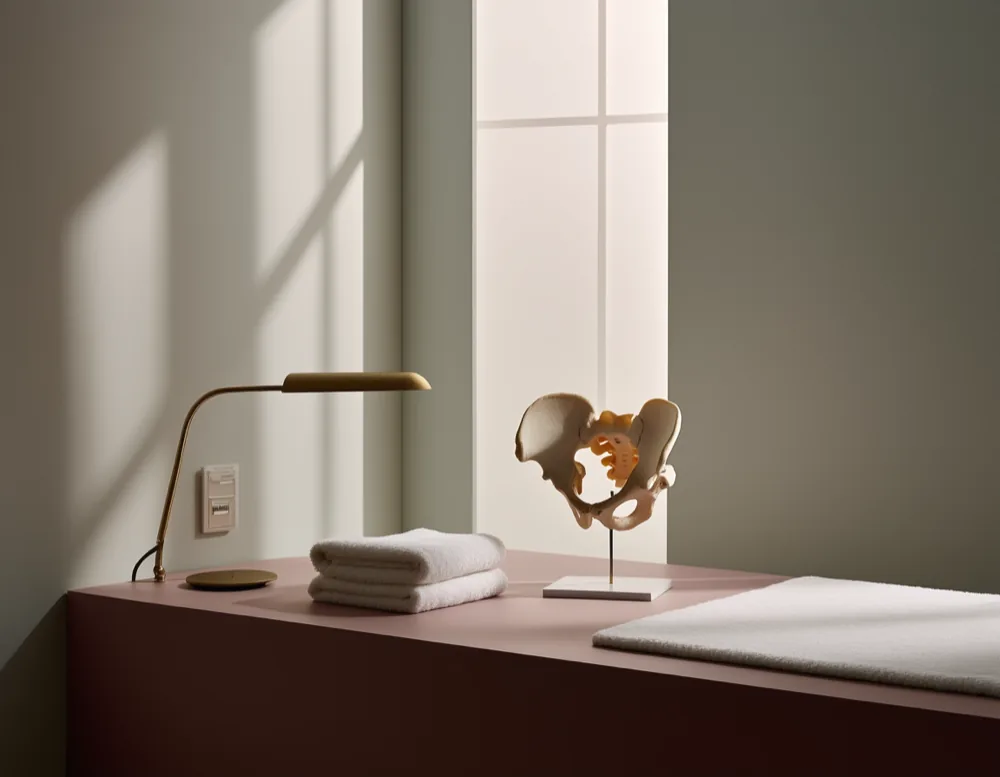
If your symptom is not on this list, it is still worth asking. A short telephone call with a therapist costs nothing and often saves an appointment.